This week’s Passive House sweep: credits, multifamily, heat pumps, and a Climate 4A case study
Federal efficiency credits are mostly history, Phius multifamily keeps scaling, PHI tightened heat-pump criteria again—and a New Jersey Phius ZERO home shows what a Climate 4A stack can look like in the wild.

ExtraReach is still in the planning stage. Most weeks that means reading standards updates, incentive calendars, and certified projects—and deciding what actually changes the envelope, mechanicals, or budget sketch I’m carrying forward.
This week’s sweep had four clear signals: federal credits mostly gone, Phius multifamily growing fast, PHI heat-pump criteria refreshed, and a Climate 4A Phius ZERO home that looks a lot like the residential recipe I’ve been staring at.
Federal credits: mostly gone—pivot to state and utility
If you’re still writing cost posts around federal residential efficiency and clean-energy credits, the calendar has already moved. From the IRS FAQ on modifications under Public Law 119-21 (commonly called the One Big Beautiful Bill, or OBBB):
- §25C and §25D — not available after December 31, 2025
- §45L — not available after June 30, 2026 under OBBB
Reading this on September 7, 2026, that means the federal line items ExtraReach was watching for a residential Passive House timeline have largely sunset. Industry write-ups of the same OBBB changes reinforce the point: several clean energy tax credits hit hard cutoffs, including the June 30, 2026 §45L cliff.
My planning lean is blunt: pivot cost posts and pro formas to state and utility programs. Treat expired federal credits as history—not as placeholders that might magically return before shovel day.
Budget incentives from state/utility programs first. §25C/§25D and §45L are off the ExtraReach planning board for a 2026+ build calendar.
Phius multifamily: a record year worth noticing
ExtraReach is a single-home plan, but Phius’s multifamily numbers still matter— they show where raters, QAPs, and product ecosystems are putting energy. Multifamily Executive’s Q&A on Phius’s record year reports roughly 1.1 million → 2.65 million sq ft and 1,263 → 2,461 units of growth for 2025, with Massachusetts stretch code and 21 state LIHTC QAPs called out as part of the policy backdrop.
I’m not chasing multifamily certification. I am treating that growth as evidence that Passive House modeling, airtightness targets, and right-sized mechanicals are becoming normal industry language—not a niche hobby.
Watch the ecosystem, not just the badge. More multifamily sq ft usually means more familiar contractors, more product data, and fewer “we’ve never done that” conversations when a detached home asks for the same physics.
PHI heat-pump criteria v1.2 (April 14, 2026)
On the PHI side, heat pump criteria v1.2, published April 14, 2026, is the document I’m bookmarking for mechanical shortlists. The update leans into climate-point framing and a silent-mode ≤25 dB(A) expectation for recirculated-air operation—details that matter when a low-load house puts the heat pump closer to living space than a conventional install.
For ExtraReach modeling, my preference stays simple: prefer PHI-certified COPs when feeding PHPP. Certified component data won’t invent comfort by itself, but it shrinks the gap between brochure optimism and a low-load energy model.
Spec preference: PHI-certified heat-pump performance data for PHPP, and pay attention to silent-mode / recirculated-air noise limits when equipment sits near occupied rooms.
Case study: Bakrania Passive House (NJ) — Phius ZERO
The project that made this week’s reading list concrete is the Bakrania Passive House in New Jersey—a Climate 4A Phius ZERO home of about 2,210 sf, certified March 18, 2026, and named Green Builder’s 2026 Green Home of the Year.
The published stack looks familiar on purpose:
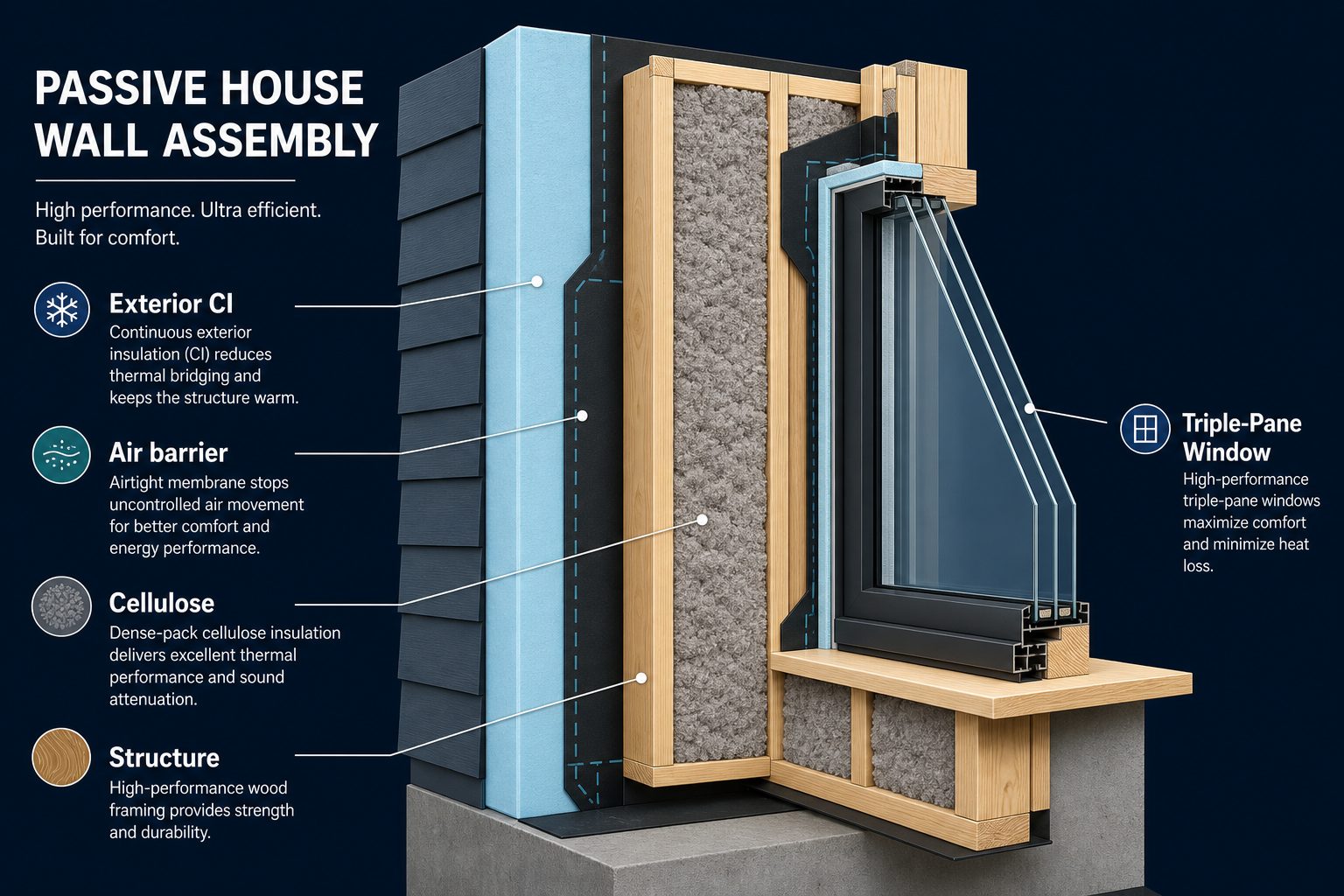
- ZIP R-12 continuous exterior insulation + cellulose
- Twin Daikin ducted air-source heat pumps
- Zehnder Q350 ERV
- Rheem heat-pump water heater
- 8 kW PV + dual Powerwall
- −6 HERS
I’m not copying the project line for line. I am filing it as a Climate 4A proof point that the “boring” envelope + right-sized ASHPs + ERV + HPWH + modest PV/storage path can land Phius ZERO performance without turning the house into a science fair.
Keep the residential recipe boring: continuous exterior insulation + cellulose, right-sized ASHPs, a serious ERV, HPWH, and only enough PV/storage to match the modeled load—not a showroom.
What I’m carrying into next week
Four practical moves from this sweep:
- Rewrite any ExtraReach cost notes that still lean on §25C/§25D/§45L—state and utility only.
- Keep reading Phius multifamily growth as an ecosystem signal, not a building-type change for this project.
- Pull PHI heat-pump criteria v1.2 into the mechanical shortlist checklist (COPs + silent-mode).
- Use Bakrania as a Climate 4A reference when comparing envelope + ASHP + ERV packages.
If you’re in the same planning lane: the federal credit menu shrank, the standards kept refining, and the good residential stack still looks like physics first. That’s enough progress for one week.
One calendar note I’m watching: PhiusCon 2026, October 8–10 in Phoenix.
Sources
- IRS — FAQs on modifications to §§25C, 25D, 45L and related provisions under OBBB (P.L. 119-21)
- Site Selection Group — Three clean energy tax credits have sunset on June 30, 2026
- Multifamily Executive — Q&A: Inside Phius’ record year in multifamily
- PHI — Criteria for heat pumps, v1.2 (April 14, 2026)
- Phius — Certified project database: Bakrania Passive House
- Green Builder Media — Form and function (2026 Green Home of the Year)